

This website uses cookie or similar technologies, to enhance your browsing experience and provide personalised recommendations. By continuing to use our website, you agree to our privacy policy. You can adjust cookie preferences in Cookie Settings.

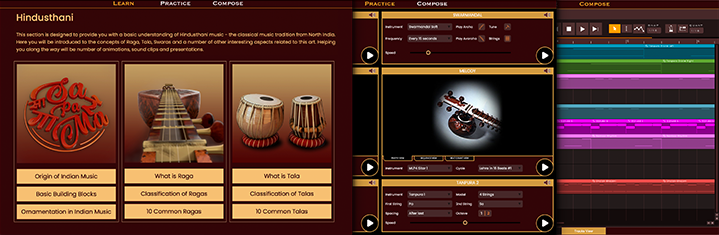
The SwarShala Indian music software includes Tabla Tarang and over 100 other perfectly sampled virtual Indian instruments.
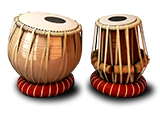
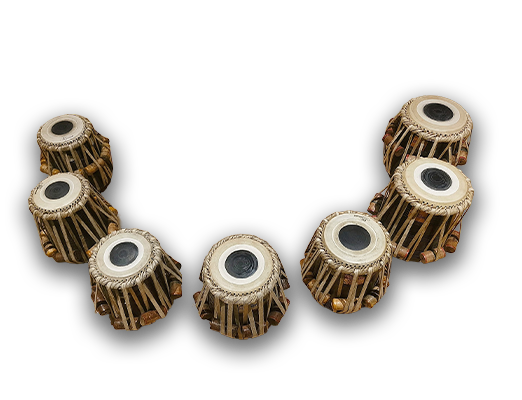
The Tabla Tarang originates from the Indian subcontinent and takes its name from tabla, the well-known hand drum, and tarang, meaning waves or a series, referring to the wave-like arrangement of drums used to produce melody. Unlike the standard tabla, which is played in a pair (dayan and bayan) primarily for rhythm, the Tabla Tarang uses multiple dayans, the smaller treble drum of the tabla pair, arranged together to create a melodic instrument.
A Tabla Tarang conventionally consists of a set of dayans, typically ranging from ten to sixteen or more, each one tuned to a specific note of a raga or scale. The drums are arranged in a semi-circular or row formation in front of the seated player, similar in layout to instruments like the Jal Tarang, though the mechanism of sound production is entirely different. Each dayan is made from a hollowed piece of wood or clay shell, with a drumhead made of layered animal skin, and a black paste called syahi applied to the center of the head, which is what gives tabla its distinctive tonal quality and allows for precise tuning.
Tuning each drum is done by adjusting the tension of the drumhead, either through tuning blocks and a hammer, similar to standard tablas, or through a system of interlaced straps and wooden dowels. The drums are tuned to match the notes required by a given raga, so a full set of Tabla Tarang drums must often be re-tuned for each performance, depending on the composition being played.
The instrument is played by striking each drum with the fingers and palms, using traditional tabla playing techniques such as strokes and finger rolls, to sound the melody across the differently tuned drums. Because it requires considerable skill in both tabla playing and precise tuning, and because arranging and maintaining a full set of tuned drums is demanding, the Tabla Tarang has remained a rare and specialized instrument. It is primarily used as a solo concert instrument in Hindustani classical music, and only a small number of skilled musicians continue to perform and preserve this tradition today.