



This website uses cookie or similar technologies, to enhance your browsing experience and provide personalised recommendations. By continuing to use our website, you agree to our privacy policy. You can adjust cookie preferences in Cookie Settings.


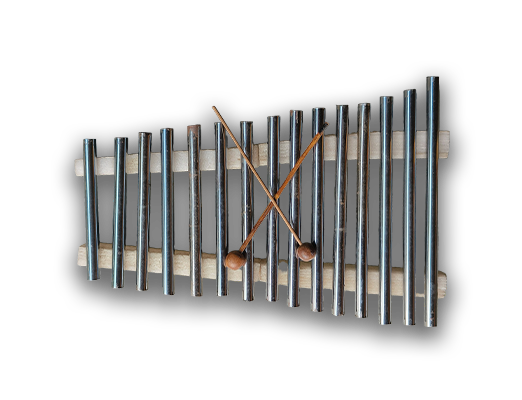
The SwarShala Indian music software includes Pipe Tarang and over 100 other perfectly sampled virtual Indian instruments.
The Pipe Tarang takes its name from tarang, meaning waves, a term shared with other Indian melodic percussion instruments such as Jal Tarang and Tabla Tarang, reflecting a common naming tradition for instruments that produce a series of melodic tones. Unlike the Glass Tarang or Tile Tarang, which use solid flat pieces of material struck like vibraphone bars, the Pipe Tarang relies on hollow metal tubes, placing it closer in construction and sound to instruments like tubular bells or the orchestral chimes used in concert percussion.
In the Pipe Tarang, each pipe is cut to a specific length to produce a particular pitch when struck, typically near the top of the tube where the strike produces the clearest fundamental tone. Because the tubes are hollow rather than solid, they resonate very differently from bars: the column of air inside the tube reinforces certain overtones, giving the instrument a ringing, bell-like sustain that lingers noticeably longer than the sound produced by a struck solid bar. The material and wall thickness of the tubing significantly affects the resulting timbre, with thinner walls generally producing brighter, more overtone-rich sounds and thicker walls producing a more focused, fundamental-heavy tone.
Tuning a set of pipes is primarily a matter of adjusting their length, since a longer tube produces a lower pitch and a shorter tube a higher one, though fine-tuning can also involve adjusting the wall thickness or, in some designs, cutting a small tuning slot near the top of the tube. The pipes are typically suspended from a frame using cord or wire passed through holes drilled near one end, at a point close to a node in the tube's vibration pattern, which allows the tube to ring freely without the mounting point damping the sound. Players strike the tubes with mallets, often ones with harder heads than those used on bar instruments, since the harder material of metal tubing responds better to a firmer strike.
As with the Glass Tarang and Tile Tarang, the Pipe Tarang is a modern, largely handmade instrument rather than part of an established classical tradition, and it is generally found in experimental, contemporary, or fusion musical settings. Its construction connects it to a broader family of tubular chime instruments found across many cultures, while its naming ties it to the same conceptual lineage as Jal Tarang and Tabla Tarang: taking an ordinary object and, through careful tuning and arrangement, turning it into a source of melody.